• Skip to primary navigation
  • Skip to main content
  • Skip to footer

DTD Lab

DTD Lab
  • Research
  • Events
  • People
  • Opportunities
  • About
  • News
  • Support
  • Subscribe

Research & Programming

Technology & Disinformation

About In the News Past Events Project Members

Overview

This study works to challenge and deconstruct long-standing stereotypes about favelas—often portrayed as hubs of disinformation due to a supposed lack of education.

Findings reveal that such assumptions are unfounded. In fact, engagement with disinformation among favela residents—who are predominantly Black—is significantly lower than among individuals from higher social classes.

This study is part of a broader initiative working collaboratively with residents to establish a local research lab, enabling them to conduct their own investigations and generate knowledge from within their communities.

The report Technology and Disinformation in the Território do Bem (Vitória-ES), published as a bilingual booklet (Portuguese and English) by Editora Milfontes, is available for download at the link below. This is the first report of its kind focused on understanding how favela residents engage with technology and disinformation, and how these interactions shape their everyday lives. The project centers on exploring the role of technology and disinformation in the daily experiences of the Território do Bem, emphasizing participatory research and community engagement as key drivers of social transformation.
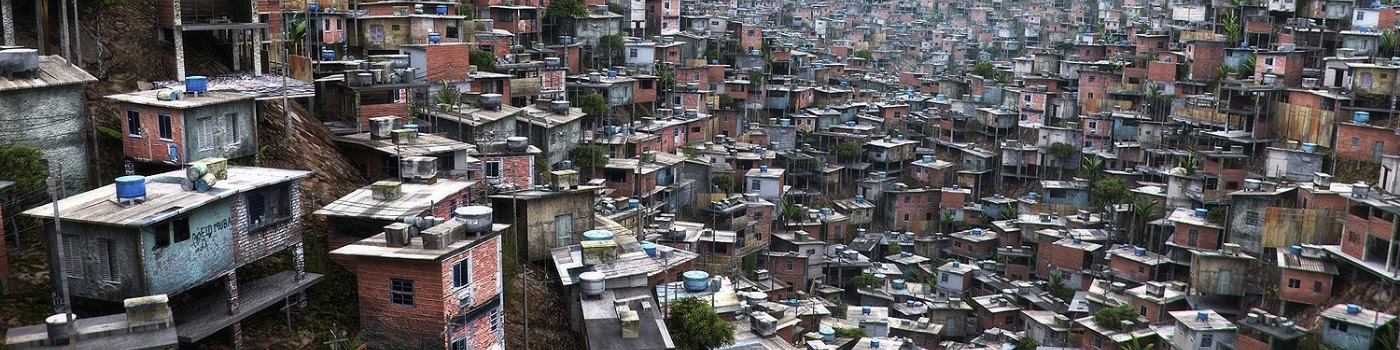
View Favela Digital

Explore Publications on Favela Digital

Learn More

In the News

Headshot of David Nemer with green wash

The Sad Legacy of the Bets

David Nemer, DTD Lab faculty co-lead, recently discussed the research he has been developing for the past two years on the impacts of online betting in favelas. The results show that bets have hijacked the passion for football and that, even if they are banned, they will leave a deep legacy of social dependence.

gamarevista.uol.com.br

Soccer players and coach on the sidelines of a game

The parallel World Cup: fake news grows and affects the Brazilian national team

Rumors and conspiracy theories gain traction and generate wear and tear, as in the case involving Ancelotti's son. David Nemer, DTD Lab faculty co-lead, explains that fake news circulates in an environment where emotions outweigh evidence. Especially during the World Cup, when emotions are running high. creating a completely inflamed environment, more conducive to misinformation.

oglobo.globo.com

As Brazilian media embrace prediction markets, experts warn of election distortion

Some news outlets have begun citing odds from unregulated betting platforms, like prediction markets, alongside survey-based polls. David Nemer, DTD Lab faculty co-lead, argues that these markets are vulnerable to manipulation and do not provide a reliable measure of voter sentiment.

latamjournalismreview.org

Past Events

  • Technology & Disinformation

Digital Democracy: The Uses and Misuses of Technology in Unequal Societies

Monday, December 9, 2024 • 10:00 AM – 5:00 PM EDT

DTD Lab, 722 Preston Ave., Ste. 201

  • Technology & Disinformation
  • Visual Misinformation

Misinformation and Image Manipulation in a Polarized America

Friday, November 22, 2024 • 11:30 AM – 12:30 PM EDT

UVA's School of Data Science and Online

See All

Project Members

Undergraduate Research Assistant

Diego DiMattina

Diego DiMattina is an undergraduate student and Echols scholar at the University of Virginia, majoring in computer science and philosophy. He works as a research assistant in the Digital Technology for Democracy Lab alongside faculty co-lead, David Nemer, and postdoctoral research fellow, André Sobral. Diego is interested in science and technology studies, political/social philosophy and computer science techniques that incorporates both interests. He has worked with the Massive Data Institute at Georgetown University studying misinformation during the 2024 election and interned at organizations implementing technologies to drive policy efforts. Diego is committed to leveraging an interdisciplinary approach to better understand how to use technology ethically in society.

Full Profile

Faculty Co-Lead

David Nemer

Affiliation

  • Associate Professor of Media Studies, Department of Media Studies, College and Graduate School of Arts & Sciences

Bio

David Nemer is an associate professor in the department of media studies, and an affiliated faculty in the department of anthropology and in the Latin American studies program at the University of Virginia. He is also a faculty associate at Harvard University's Berkman Klein Center for Internet and Society. His research and teaching interests cover the intersection of science and technology studies, anthropology of technology, ICT for development, and human-computer interaction. Nemer is an ethnographer whose fieldworks include the Slums of Vitória, Brazil; Havana, Cuba; Guadalajara, Mexico; and Eastern Kentucky, Appalachia. Nemer is the author of Technology of the Oppressed (MIT Press, 2022), winner of the Marcel Roche Award, and Favela Digital: The other side of technology (Editora GSA, 2013). He holds an MA in anthropology from the University of Virginia, an MS in computer science from Saarland University, and a PhD in computing, culture, and society from Indiana University. Nemer has written for The Guardian, El País, The Huffington Post (HuffPost), Salon, The Intercept, UOL, and CartaCapital.

Full Profile

2024-26 Postdoctoral Research Fellow

Andre Sobral

Andre Sobral, a postdoctoral research fellow with UVA's Digital Technology for Democracy Lab, is a sociologist specialized in science and technology studies. Motivated by a passion for comprehending social change, Sobral has studied interpersonal relationships and political activism mediated by social networks. His enthusiasm lies in collaborative work within creative teams, where collective thinking and academic knowledge are applied to address real-world challenges. Sobral earned a bachelor of sociology at the Federal University of Bahia in Salvador, Brazil, and a master's degree and PhD of systems engineering and computer science at the Federal University of Rio de Janeiro. Previously, he was a researcher at the international project on community resilience “Understanding Risks & Building Enhanced Capabilities in Latin American Cities." Sobral also collaborated as a voluntary researcher at the Informatics & Society Laboratory and at the Aaron Swartz Brazil Institute.

Full Profile

Make a gift to support the Lab's interdisciplinary research, initiatives, and activities

Support the DTD Lab

Donate

Footer

DTD Lab
  • Non-Discrimination Notice
  • Consumer Information
  • Accessibility
  • Emergency
  • FOIA
  • Privacy
  • Subscribe

Contact Us

722 Preston Avenue, Suite 201 Charlottesville, VA 22903

uva-dtdlab@virginia.edu

YouTube

Site by Charlottesville SEO Web Development.

© 2026 By the Rector and Visitors of the University of Virginia